Technical Product Information
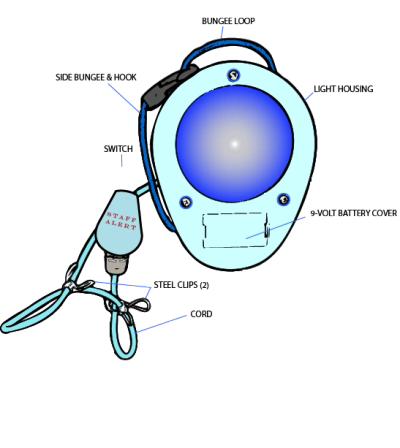
Specifications and practical information for purchasing, clinical engineering, and department teams reviewing Call Ball.
Power & Operation
- Power source: One replaceable 9-volt alkaline battery.
- Battery runtime: Manufacturer-reported runtime of up to 70 hours of continuous illumination, or approximately 6–8 months of routine use. Actual battery life varies with use.
- Battery replacement: Replace the battery when the blue light dims or begins to flicker. Battery life varies with use.
- Activation: Press the handheld switch once to turn the light on; press again to turn it off.
- Signal: Blue LED visual alert; no audible alarm or remote notification.
- Setup: No outlet connection, software, central monitoring, or IT integration required.
Materials & Components
- Main housing: High-impact ABS plastic.
- Light dome: Polycarbonate.
- Handheld switch housing: High-Impact ABS plastic
- Switch mechanism: Stainless steel, rated for 500,000 operating cycles. Copper under the switch for infection control from bacteria and viruses.
- Switch touchpoint: Pure copper.
- Cord covering: Mono-flex PET braided sleeving.
- Positioning hardware: Bungee loop, side bungee and hook, and two steel clips for cord management and switch positioning.
Construction & Durability
Designed and manufactured in Maine, Call Ball uses a simple circuit with connections and components selected for strength and durability. It is assembled by skilled craftspeople and tested prior to shipping. Consult the Owner's Manual for our pledge of quality and warranty .
Internal housing ribs provide added strength and impact resistance. The product is designed for years of reliable use and allows repair when needed, with replacement-part support available through ISAR LLC.
Placement & Function Checks
Secure the light housing to a suitable anchor point where staff can clearly see the activated beacon. Position the switch within the patient’s reach and arrange the cord to avoid entanglement, tripping, or interference with nearby equipment.
Check that the switch and light operate correctly before issuing Call Ball to a patient.
Cleaning & Maintenance
Do not immerse Call Ball in water.
The Call Ball is best cleaned with a dilute (20% Isopropyl Alcohol) cleaning solution or soap and water. For issues requiring more intense deep cleaning, a Bleach-based solution and liberal application may be used.
Never use Acetone to clean the Call Ball.
Clinical Engineering & Product Review
Contact ISAR LLC with requests for circuit information, component documentation, or testing records needed for your institution’s review.
Facility inspection and approval processes if required by your facility should be followed before using the Call Ball.
Email: isarllc@yahoo.com
Appropriate Use
Call Ball is intended for appropriate patients who can understand and activate the device, in care spaces where staff can see the illuminated alert. The care team determines suitability of the patient intended to use the Call Ball, and optimal location/placement of the light.
It does not replace the usual nurse call systems, nor does it replace clinical monitoring, rounding, or observation. It is intended to only provide a part of a more comprehensive fall precaution/prevention programs and allow for another tool to help with safety protocols. The use of the Call Ball cannot guarantee response time of the staff.
Purchasing Support
Need an invoice, purchase-order information, or vendor setup documents? Visit our purchasing page.